
Hidden within the folds of time, Rājendra Chola I’s copper plate charter offers a glimpse into the grandeur of a thousand years ago. These ancient plates, inscribed in both Sanskrit and Tamil, are more than just royal decrees—they are a reflection of a vibrant culture where tradition and power came together in harmony.
The Tiruvalangadu copper plates, issued by Emperor Rajendra Chola between 1012 and 1044 A.D., are invaluable historical records, shedding light on the administrative and cultural practices of the Chola dynasty. These plates, a set of 31 copper sheets, were used to document significant royal edicts and land grants, often securing the emperor’s decisions with a large, circular copper seal emblazoned with the royal emblem of the Chola dynasty.
These copper plates were not just administrative tools; they were meant to preserve the emperor’s legacy and decisions for posterity, ensuring that his edicts and land grants were honored and passed down through generations. The inscriptions provide a direct link to the Chola dynasty’s grandeur, serving both as historical records and as symbols of Rajendra Chola’s authority and prosperity. These plates take us back to a golden age of Tamil history, where language was not just a means of communication but a bridge between the sacred and the everyday.
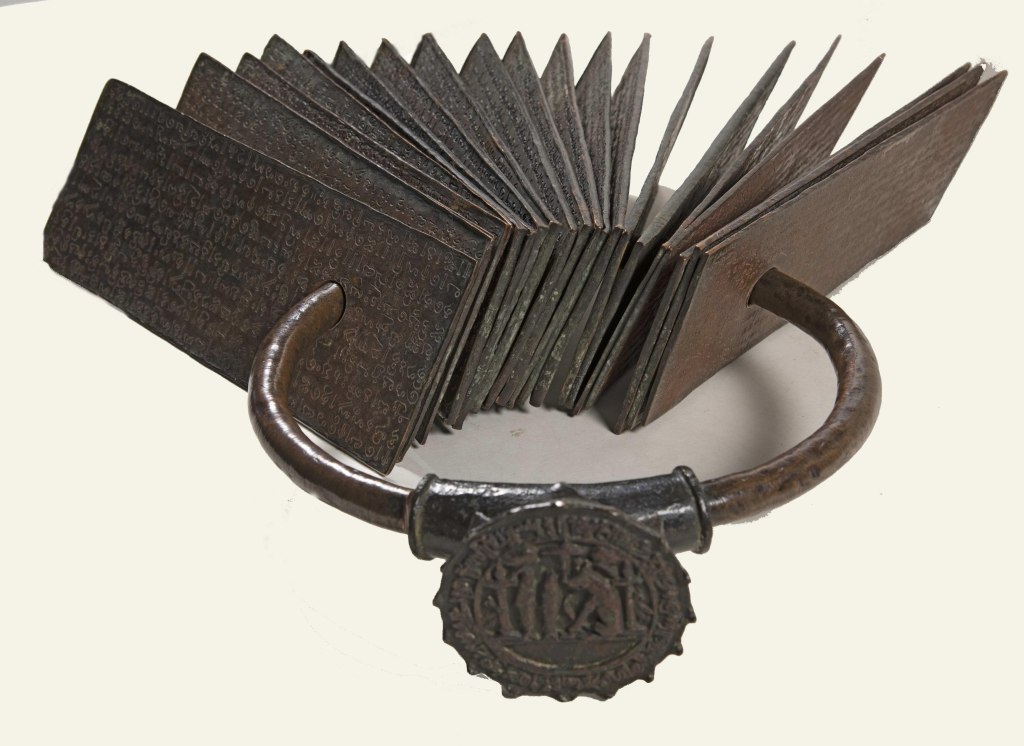
The Structure of this 1000 year old Charter: A Dual-Language Document
The charter is a remarkable artifact from the Chola era, inscribed in two distinct sections:
- Sanskrit Section (5 Plates)
- Written in the Grantha script, this section emphasizes the genealogical and mythological roots of the Chola dynasty.
- Beginning with an invocation to Vishnu, it traces the lineage of the Chola kings, linking them to divine solar ancestors. This use of Sanskrit reflects its role as a language of divine legitimacy and pan-Indian cultural unity.
- Tamil Section (16 Plates)
- This section focuses on administrative and historical details, especially the reign of King Rājarāja I (985–1012 CE), the father of Rājendra Chola I.
- It recounts a significant royal decree: the donation of an entire village’s revenue and land to construct a Buddhist vihara (shrine) in Nagapattinam, a coastal port town.
The charter’s bilingual nature exemplifies the dual linguistic traditions that coexisted in Tamil Nadu, serving complementary functions in governance, culture, and religion.
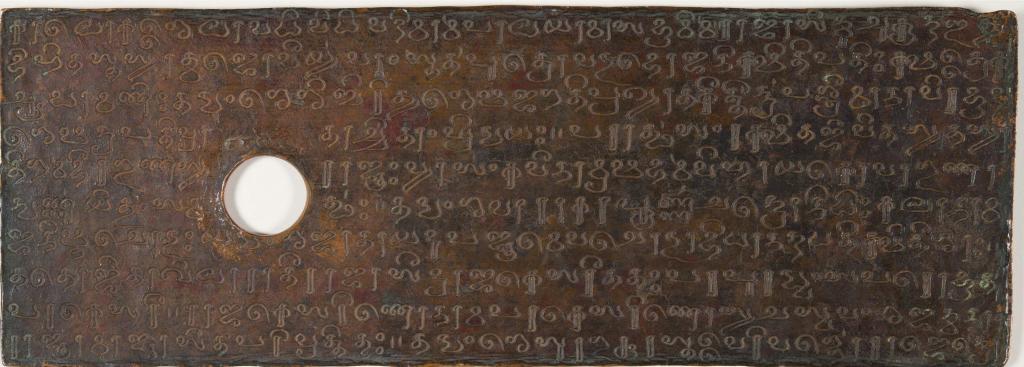
Sanskrit Copper Pates: The Language of Divinity and Universality
The Sanskrit portion of the charter highlights its revered status as a language of classical learning, ritual, and legitimacy. The invocation to Vishnu, followed by genealogical accounts, situates the Chola dynasty within a cosmic order. Sanskrit’s widespread use in inscriptions and religious texts across India allowed the Cholas to assert their authority on a broader cultural and political canvas.
Sanskrit’s role in Tamil culture can be summarized as follows:
- Sacred Authority: Sanskrit was often associated with Vedic traditions, temples, and spiritual hymns, granting divine sanction to political acts.
- Cultural Integration: By adopting Sanskrit for genealogical records, the Cholas aligned themselves with pan-Indian dynastic traditions, enhancing their prestige.
- Scriptural Legacy: Grantha script, used in the charter, facilitated Sanskrit’s transmission while coexisting with Tamil scripts, underscoring linguistic pluralism.
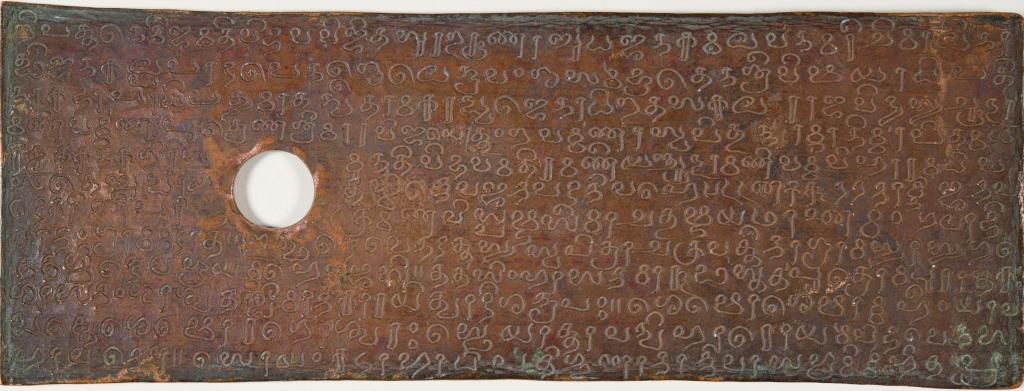
Tamil Copper Plates: The Language of the People and Administration
While Sanskrit conferred spiritual gravitas, Tamil was the language of the land, deeply rooted in the region’s identity and administrative systems. The Tamil section of the charter reveals its critical role in documenting governance, royal decrees, and local affairs.
Highlights of Tamil’s prominence in the charter:
- Administrative Use: Tamil served as the medium for recording royal orders, such as King Rājarāja I’s declaration regarding the Nagapattinam vihara.
- Cultural Resonance: Tamil inscriptions connected rulers with their subjects, celebrating local heritage and ensuring the accessibility of royal decrees to the people.
- Literary Tradition: The Tamil language was already flourishing as a literary powerhouse, with its own corpus of classical Sangam poetry and devotional Bhakti literature.
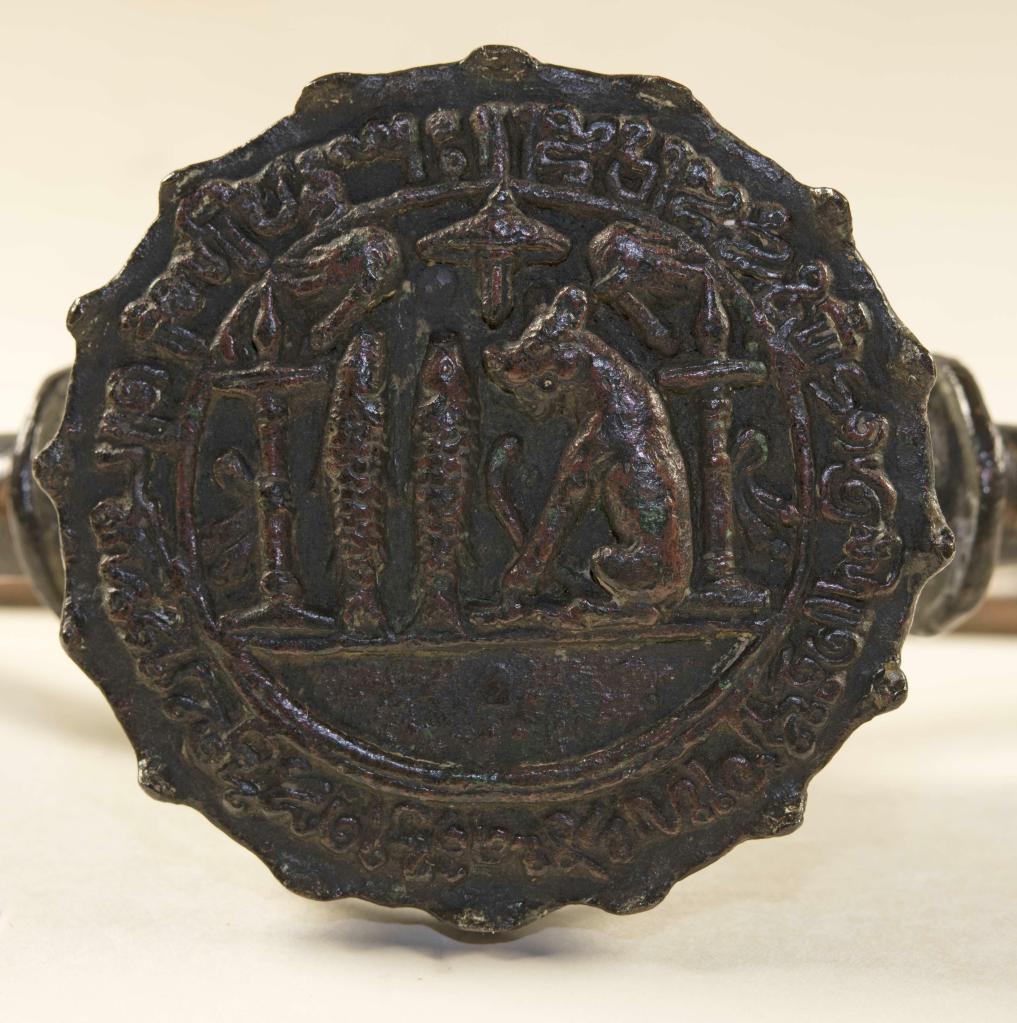
Official Seal of Rajendra Chola:
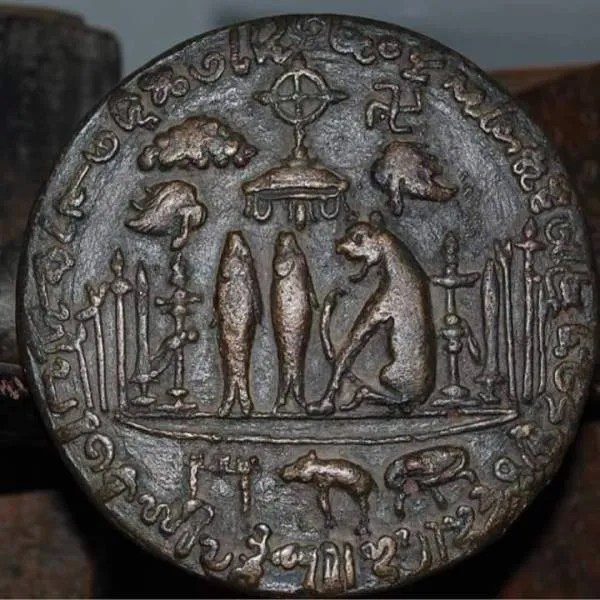
- This is the official seal of the great Rajendra Chola. It shows a roaring tiger (symbol of Cholas) seated in front of twin fishes (symbol of Pandyas)….and above the bow & boar (symbol of Cheras & Chalukyas respectively).
- The seal signifies Chola subjugation of all those great dynasties.Above it there is a royal parasol(chatra) flanked by fly whisks & topped by a chakra(wheel) – which are insignia of a Chakravartin ruler.
- In some seals, Swastika & flowers are depicted as sign of auspiousness on both side of chakra while Lamps and weapons flank the tiger and twin fishes.
Sanskrit legend surrounds the seal & reads
“Etad Rajendra Cholasya
Parakesarivarmanah
Rajad rajanya mukuta
sreni ratnesu sasanam”
“This is the order of Rajendra Chola alias Parakesarivarman, which rest on the crest jewel of all the reigning kings”
The Legacy of Linguistic Pluralism in Tamil Nadu
The coexistence of Sanskrit and Tamil in this charter encapsulates the inclusive spirit of Tamil culture during the Chola era. Far from being in conflict, the two languages functioned in a symbiotic relationship:
- Sanskrit represented universality, sacred authority, and pan-Indian connectivity.
- Tamil embodied regional pride, administrative efficacy, and cultural identity.
This duality enriched Tamil Nadu’s cultural heritage, fostering a society where the divine and the everyday coalesced seamlessly.
In recent times, there has been a growing trend among certain Dravidian ideological groups in Tamil Nadu to cast Sanskrit as an outsider language, supposedly imposed upon the Tamil people. This narrative often dismisses Sanskrit’s significant role in shaping Tamil Nadu’s history, portraying it as a tool of religious and political dominance. While such rhetoric may serve short-term ideological purposes, it risks undermining the rich and inclusive heritage of Tamil civilization.
The historical evidence, however, tells a different story. Artifacts like Rājendra Chola I’s copper plate charter remind us that Sanskrit and Tamil coexisted harmoniously in Tamil Nadu’s cultural and intellectual spheres. Sanskrit served as a bridge to pan-Indian traditions, offering divine legitimacy and connecting Tamil Nadu with a broader cultural and spiritual framework. Tamil, equally vital, represented the language of the land, administration, and the people, capturing the region’s unique identity. Together, these languages shaped the Chola empire’s legacy as a beacon of cultural and political brilliance.
By attempting to erase Sanskrit’s contributions, such groups deny the pluralistic essence of Tamil Nadu’s past. The truth is that Tamil Nadu’s greatness lies in its ability to integrate the local and the universal, with both Sanskrit and Tamil at its heart. To preserve this legacy, it is crucial to celebrate the interplay of both Sanskrit & Tamil, which together created the enduring foundation of Tamil civilization – irrespective individual opinions, that’s the truth!
 Project Shivoham