

The Vishnu Sahastra Namavali, also known as Vishnu Sahastranama Stotra, is a revered hymn in Hindu tradition that comprises one thousand names of Lord Vishnu. It is part of the Mahabharatam, found in the Anushasana Parvam (Book of Final Instructions by Bheeshma). The hymn is a conversation between the warrior Bheeshma Pitamaha, who is on his deathbed on the battlefield of Kurukshetra, and Yudhishthira. Bheeshma Pitamaha emphasizes that chanting the names of Bhagavan Sri Maha Vishnu enables one for attaining liberation (moksham).
At the end of the Vishnu Sahastra Namavali, Bheeshma Pitamaha recites the following…
श्रीराम राम रामेती रमे रामे मनोरमे ।
सहस्रनाम तत्तुल्यं रामनाम वरानने ॥
“Sri Rama Rama Ramethi Rame Rame Monorame,Sahastra Nama Thathulyam Rama Nama Varananey”.
If anyone just says “Sri Rama Sri Rama Sri Rama“ for 3 times in a row, that is equal to reciting the entire Vishnu Sahastra Namavali for one time. The essence of entire Vishnu Sahastra Namavali is encoded in just one name – Sri Rama… said Mahadev to Maa Parvati.
But why? What’s so special with the name ‘Sri Rama’? In Hindi, we have this phrase about Bhagvan Shri Ram – तुझासे बी बढ़ाके तेरा नाम, which means, ‘Your Name is much greater than Yourself’. It is a very popular saying that the name of Rama is much greater than the Bhagvan Sri Rama himself. All the way more Jai Shri Ram reverberates across Bharat – in every small village & in every nook & corner. Why not Jai Sri Krishna or Jai Sri Vishnu of Jai Shiva or Jai Shakthi?
There is only one place on this earth where you can find answer to this question…. & that is KASHI.
Kashi – the city older than the time itself; holds the epitome of Bharatiya Asthitvam (The soul of Bharat’s Civilization). There is a very popular saying about Kashi as follows – “Around the world, people die every minute to live & its only in Kashi, people live every minute to die in Kashi”. Passing away in Kashi is revered as the highest & final virtue that one could possibly attain in life AFTER fulfilling one’s due responsibilities with regards to one’s own family & children.
The answer lies in Agni Puranam,348th Chapter. In Samskrutam, Eka Akshara Pada (Mono-syllabic words) exist. It means just a simple & single letter will have meanings defined in Samskrutam. Rama as we know is made of 2 syllables – Ra & Ma.
According to Agni Puranam, both these syllables have certain meanings associated in Samskrutam.
Ra = Fire, Burning, Knowledge
Ma = Mother, Birth, Progeny
According to the Punarjanma (Rebirth), which is the core philosophy of Sanatana Dharma, the soul of the departed ends one leg of its journey with the burning of the dead body and enters another new body taking rebirth as a new living being. This is the eternal cycle of birth, death, birth & so on… a breakaway from this cycle is the most desired virtue in Sanatana Dharma, which is called Moksham. Exact same philosophy applies in other Dharmic paths of Buddhism & Jainism as well and revered as Nirvana.
The Ra signifies Death (symbolically with Fire / burning of the corpse) and Ma signifies Birth (symbolically with a new Mother). This eternal cycle of Ra, Ma, Ra, Ma…. is meant to be broken and one need to attain the final state of unifying of Jeevathma (Self) with Paramathma (Supreme Consciousness). Rama is that word that constantly reminds all of us that one should finally be breakaway from this eternal cycle and reach the final unifying state. It is revered that chanting “Rama” will help us realize the temporal state and aspire for the final state of bliss. Bhagavan Shri Ram is the one who could pull out all living beings from this eternal cycle and hence Jai Shri Ram holds such an unparalleled spiritual significance in Bharat.
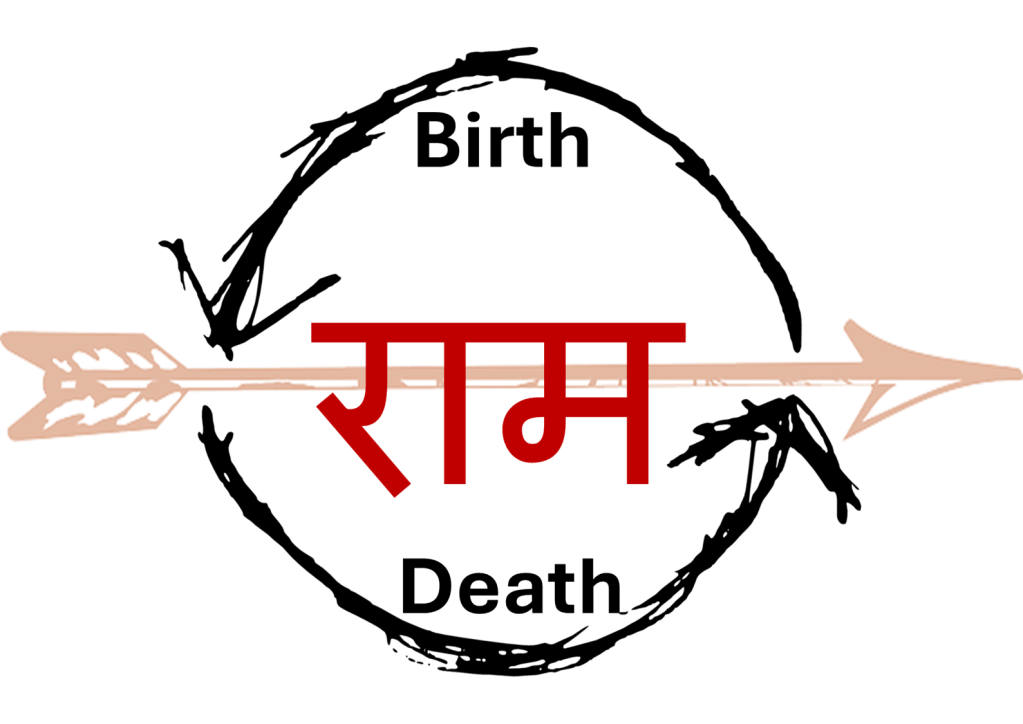
This is the reason, in Kashi, Ram Nam Satya Hai is chanted while cremating the dead. This is the reason why Mahadev said that if you cannot chant the entire Vishnu Sahasra Namavali, just chanting 3 times Rama – Rama – Rama is as pious & powerful in its letter & spirit. This is the reason why in Hindi, we revere तुझासे बी बढ़ाके तेरा नाम. This is the reason why Rama is the beating heart of Bharatiya Asthithvam.
This is the Unknown Meaning of Sri Rama to most of us… but now we know!
Here below is a detailed video on this topic from Project Shivoham…
 Project Shivoham